Ultrasonic Pulse Velocity (UPV) testing is a non-destructive method that measures the velocity of ultrasonic waves traveling through concrete. Wave velocity correlates with concrete density, elastic properties, and quality. UPV testing detects voids, cracks, and deteriorated areas, assesses uniformity, and provides strength indication. It's widely used for quality control and structural assessment without damaging the concrete.
Principles of UPV Testing
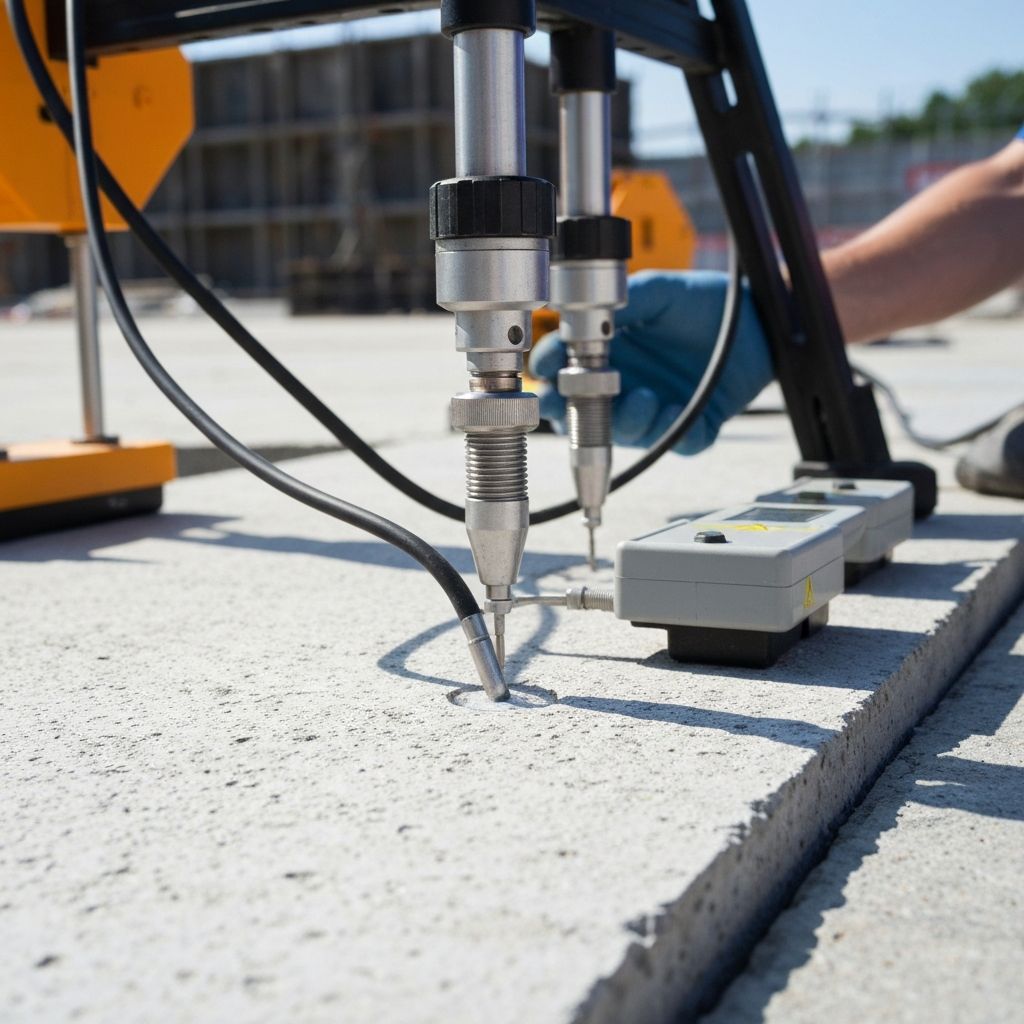
Ultrasonic waves travel faster through dense, homogeneous materials. In good quality concrete, pulse velocity typically ranges from 3500-4500 m/s. Lower velocities indicate voids, cracks, or poor quality concrete. The test measures transit time for ultrasonic pulse between transmitter and receiver transducers placed on opposite concrete faces (direct transmission) or same face (indirect or semi-direct transmission).
Testing Procedure and Equipment
Modern UPV equipment consists of pulse generator, transducers (typically 54 kHz frequency), amplifier, and timing display. Couplant (grease or gel) ensures acoustic contact between transducers and concrete surface. The instrument measures pulse transit time in microseconds, automatically calculating velocity from known path length.
- Direct transmission (opposite faces): Most accurate, path length = member thickness
- Semi-direct transmission (adjacent faces): Used when only one face accessible
- Indirect transmission (same face): Least accurate, used for surface layer assessment
- Grid measurements for mapping quality variations across large areas
- Take multiple readings and average to improve reliability
Interpreting UPV Results
EN 12504-4 provides quality classification: Excellent (>4500 m/s), Good (3500-4500 m/s), Fair (3000-3500 m/s), Poor (<3000 m/s). Velocity alone doesn't determine strength but can indicate relative quality. Calibration curves relating UPV to compressive strength can be developed for specific concrete mixes. Sudden velocity drops indicate defects, cracks, or voids requiring investigation.
Applications and Limitations
UPV testing assesses concrete uniformity, detects deterioration, locates voids and honeycombing, estimates crack depth, evaluates fire damage, and monitors strength development. Limitations include sensitivity to moisture content, reinforcement interference, and aggregate type effects. Results should be combined with other non-destructive methods (rebound hammer, core testing) for comprehensive assessment.
Conclusion
UPV testing provides valuable non-destructive assessment of concrete quality and uniformity. Our experienced technicians perform UPV surveys with modern equipment and interpret results in structural context. Contact us for non-destructive testing services.
Related Testing Services
- Rebound Hammer Testing
- Core Sampling
- Ground Penetrating Radar
- Impact Echo Testing
Applicable Standards
Need This Testing Service?
Our accredited laboratories and field teams provide comprehensive testing services across Europe.
Contact Our Team