Aggregate moisture content and specific gravity are fundamental properties required for accurate concrete mix design and batching. Moisture content determines actual water contribution from aggregates, affecting water-cement ratio and concrete strength. Specific gravity enables volume calculations, mix proportioning, and identifying contamination or poor-quality aggregates. These tests are performed routinely in quality control laboratories.
Understanding Aggregate Moisture States
Aggregates exist in four moisture conditions: oven-dry (OD, 0% moisture), air-dry (some internal moisture), saturated surface-dry (SSD, pores filled but surface dry), and wet (surface moisture plus internal). Mix designs specify SSD condition. Actual aggregates contain surface moisture (adds to mix water) or require water absorption (subtracts from mix water). Accurate moisture determination prevents water-cement ratio errors.
Moisture Content Testing Procedure
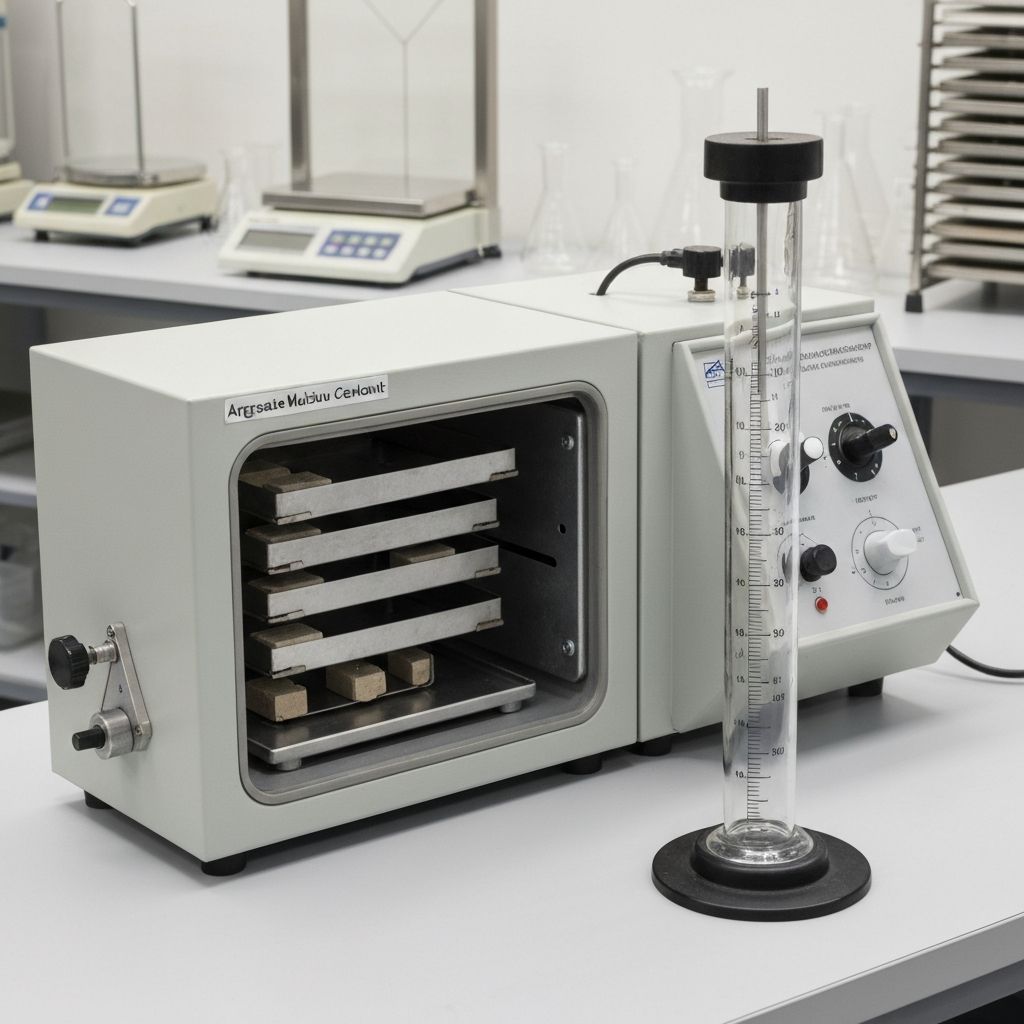
A representative aggregate sample is weighed wet, then dried to constant mass in 110°C oven (typically 24 hours for coarse aggregate, 48 hours for fine aggregate). The sample is reweighed after cooling in desiccator. Moisture content calculated as: MC% = [(Wwet - Wdry) / Wdry] × 100. Negative values indicate absorption required to reach SSD. Results guide water adjustment in batching.
- Sample size: 500g minimum for fine aggregate, 2-3kg for coarse aggregate
- Drying temperature: 110°C ± 5°C until constant mass (±0.1% change)
- Microwave and rapid moisture meters available for quick field testing
- Test frequency: Daily at batch plant, before each mix design adjustment
Specific Gravity and Absorption Testing
Specific gravity (relative density) compares aggregate density to water density. Three values are determined: Bulk Specific Gravity (BSG), Bulk SSD Specific Gravity, and Apparent Specific Gravity. The test involves weighing SSD sample in air and suspended in water, then oven-drying. Results range from 2.4-2.9 for normal aggregates. Values <2.4 suggest lightweight or contaminated material; >2.9 suggests heavy minerals.
Applications in Mix Design and Batching
Specific gravity enables calculating aggregate volumes from weights in mix designs. Absorption values (typically 0.5-2% for coarse, 1-3% for fine) determine water adjustment needed when batching. If aggregates are wet (surface moisture), subtract this water from batch water. If aggregates are dry (below SSD), add absorption water. Batch plant computers make automatic adjustments based on moisture sensor data.
Conclusion
Accurate aggregate moisture and specific gravity testing ensures proper concrete mix proportioning and consistent quality. Our laboratory performs these tests daily to support concrete production quality control. Contact us for aggregate testing services.
Related Testing Services
- Aggregate Grading Analysis
- Slump Testing
- Concrete Mix Design
- Batch Plant Calibration
Applicable Standards
Need This Testing Service?
Our accredited laboratories and field teams provide comprehensive testing services across Europe.
Contact Our Team