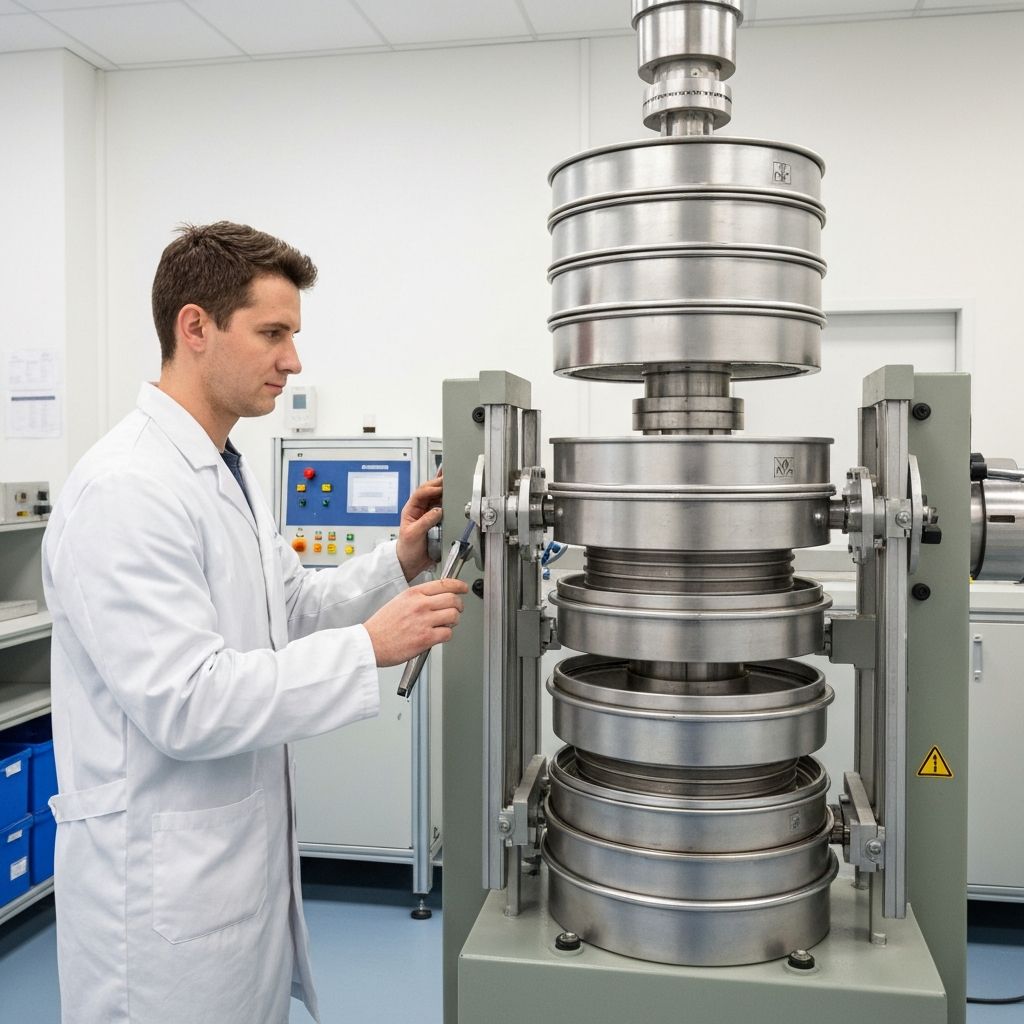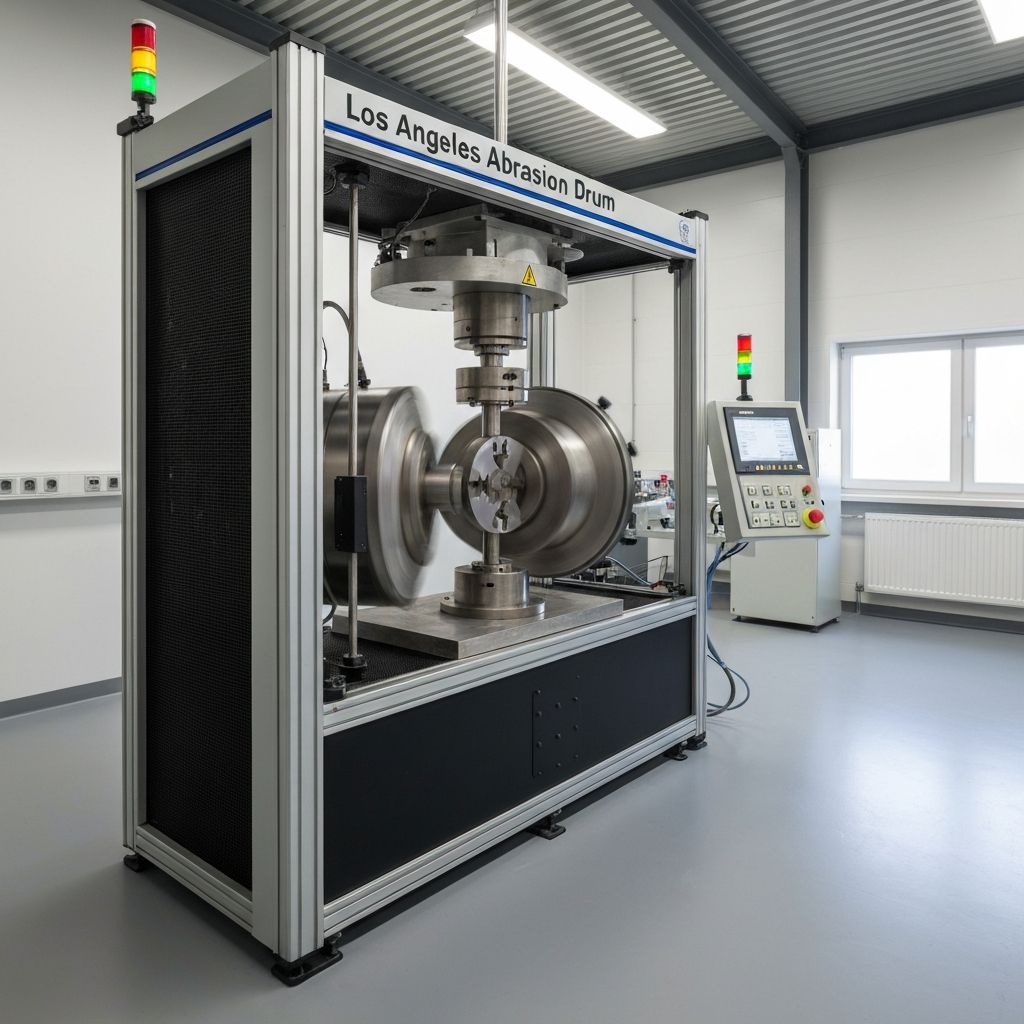
The Los Angeles (LA) abrasion test measures aggregate toughness and resistance to degradation from abrasion and impact. It simulates the mechanical breakdown that occurs during mixing, placing, compacting, and service life. High abrasion resistance is critical for pavement aggregates, high-traffic floors, and concrete subject to wear. The test is required for aggregate approval in most highway and infrastructure specifications.
Test Principle and Procedure
A specified graded aggregate sample (typically 5kg) is placed in a rotating steel drum (diameter 711mm, length 508mm) with a charge of steel balls. The drum is rotated 500 revolutions at 30-33 rpm. The tumbling action and steel balls cause particle breakdown through impact and abrasion. After testing, the sample is sieved on a 1.7mm sieve. Material passing (degraded particles) is expressed as a percentage of the original sample weight - this is the LA coefficient.
- Standard gradings: A, B, C, D depending on aggregate nominal size
- Steel ball charge: 7-12 balls depending on grading
- Rotations: 500 for coarse aggregate, 100 for fine aggregate
- Result: Percentage loss by weight = LA coefficient
- Lower values indicate better quality (higher toughness)
Interpretation and Acceptance Criteria
LA coefficient ranges from <15% (excellent) to >50% (poor). Most pavement specifications require LA < 30-35% for base course and LA < 25% for wearing course. High-quality crushed rock typically achieves 15-25%. Weak or weathered rock may exceed 40%. Low abrasion resistance indicates the aggregate will degrade during construction and service, creating fines, losing strength, and reducing durability.
Applications and Limitations
LA abrasion testing is mandatory for highway aggregates, airport pavements, concrete pavements, railway ballast, and industrial floors. It correlates with aggregate durability, crushing strength, and resistance to handling degradation. However, it doesn't directly measure polishing resistance (tested separately) or freeze-thaw durability. Correlation with field performance has been established over decades of pavement research.
Quality Control and Frequency
Testing is performed during aggregate source approval (quarry qualification), at regular intervals during production (monthly or per 20,000 tonnes), and if visual changes in rock quality are observed. Results should be consistent for a given source. Significant increases in LA value indicate weathered rock, geological variation, or changes in processing. Failed tests require source investigation or rejection.
Conclusion
LA abrasion testing ensures aggregates possess adequate toughness for demanding applications. Our accredited laboratory performs LA testing to international standards with calibrated equipment. Contact us for aggregate qualification and quality control testing.
Related Testing Services
- Aggregate Impact Value
- Aggregate Crushing Value
- Polished Stone Value
- Soundness Testing
Applicable Standards
Need This Testing Service?
Our accredited laboratories and field teams provide comprehensive testing services across Europe.
Contact Our Team